ExcerptFrom the Introduction:
This book tells the riveting story of woman suffrage with a focus on those women in Massachusetts who shaped both the national and state movements. Why concentrate on this one state? Indeed, why emphasize the suffrage campaign in any state when women ultimately gained the vote through adoption of the Nineteenth Amendment to the United States Constitution? The answer is that the traditional story about woman suffrage, which focuses on the Seneca Falls Convention as the origin of the movement and Susan B. Anthony and Elizabeth Cady Stanton as the heads of it, omits essential parts of the full story. The women’s rights movement began in Massachusetts, the nation’s most important abolitionist center. In 1837, Angelina and Sarah Grimké traveled throughout the state lecturing about the evils of slavery. When criticized for departing from a “woman’s sphere,” the Grimké sisters defended their right to have a voice in public debates about political issues. From the outset, they also set their sights on a larger prize. “I contend,” Angelina Grimké wrote, “that woman has just as much right to sit in solemn counsel in Conventions, Conferences, Associations and General Assemblies, as man – just as much right . . . [to sit] in the Presidential chair of the United States.” . . . The Grimké sisters inspired a small band of bold women and men to defend a woman’s right to publicly condemn slavery. Lucy Stone of Massachusetts took the next step in 1847. Committed to both women’s rights and abolitionism, she delivered the first lectures devoted solely to what she described as the “elevation of her sex.” The following year, several hundred women from upstate New York gathered at a convention in Seneca Falls, where Elizabeth Cady Stanton and Lucretia Mott led calls to end gender- based discrimination. Stone and other Massachusetts-area activists decided the time was ripe to launch an organized, national women’s rights movement. They hosted the First National Woman’s Rights Convention in Worcester in 1850. Throughout the 1850s, these activists, soon joined by Susan B. Anthony, organized annual national conventions and worked to advance the rights of women while continuing to speak out against slavery. When the Civil War began, activists placed the nascent women’s movement on hold to concentrate on the crisis at hand. While many women assisted the Union army as nurses or assumed new roles on the homefront, Stone, Anthony, and Stanton joined the political effort to amend the Constitution to end slavery permanently. Once the bloody war ended and the Thirteenth Amendment was ratified, securing voting rights for the disenfranchised became the next battleground. The three expected their male associates from the abolitionist movement to seek expansion of the franchise to include women as well as black men. But their former allies prioritized black male suffrage. The Fourteenth Amendment, which introduced the word male into the Constitution, was adopted in 1868. The following year, Congress proposed the Fifteenth Amendment, which would grant the vote to black men but not to women. In the wake of this exclusion, a schism divided the three women. Though disheartened, Stone supported ratification of the Fifteenth Amendment while pledging to continue the campaign for woman suffrage. Anthony and Stanton, however, opposed the Fifteenth Amendment because it omitted women. In 1869, the former friends, now bitter rivals, formed competing associations. Stone created the Boston-based American Woman Suffrage Association (AWSA), and Stanton and Anthony formed the New York– based National Woman Suffrage Association (NWSA). Even after the Fifteenth Amendment was ratified in 1870, the schism continued. Stone found Anthony’s and Stanton’s racist commentary during the debate over the amendment unpardonable. The two camps disagreed sharply over strategy as well. NWSA concentrated on urging Congress to enfranchise women nationwide. AWSA recognized—correctly, as history would prove—that Congress would act only after suffragists had successfully persuaded a critical number of individual states to grant women the vote. AWSA supported the growth of state and local suffrage associations and worked with them to wage a series of state campaigns. Stone also founded the Boston–based weekly newspaper the Woman’s Journal, which was the communications hub of the woman suffrage movement. Why is the work of AWSA, arguably the more vital branch of the divided suffrage movement, not better known? During the acrimonious schism, Anthony and Stanton molded historic memory by writing an influential one-sided account of the first decades of the movement. Their version elevated their own importance and that of Seneca Falls and minimized (and in some instances, virtually erased) the essential contributions of Lucy Stone, the Worcester Convention, and AWSA. The dominance of their account continues today. The proposed redesign of the ten-dollar bill, for example, features Anthony and Stanton but not Stone. One goal of this book is to raise Lucy Stone and her local allies to their rightful stature in the suffrage narrative. |
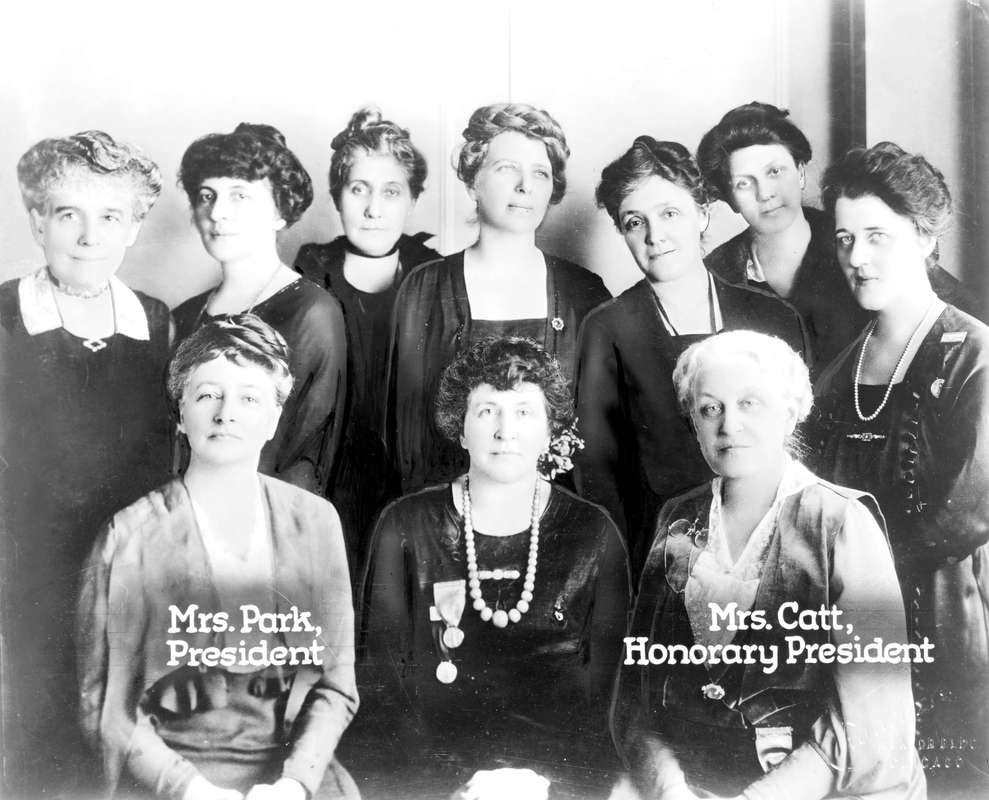
The first Board of the League of Women Voters, the successor organization to the National American Woman Suffrage Association. Maud Wood Park, a Radcliffe graduate, founded the Boston Equal Suffrage Association for Good Government and the College Equal Suffrage Association, and led lobbying efforts for the 19th Amendment in Washington, D.C. As president of the National American Woman Suffrage Association, Carrie Chapman Catt orchestrated its Winning Plan. Courtesy, Library of Congress.
|

|
|


|
© 2019 Barbara F. Berenson,
all rights reserved. |
Massachusetts in the Woman Suffrage Movement is published by The History Press. Walking Tours of Civil War Boston is an official guidebook of the Freedom Trail Foundation®, Boston, MA. Freedom Trail® is a registered trademark of the Freedom Trail Foundation. Boston and the Civil War: Hub of the Second Revolution is published by The History Press.
Website Design by Annalise Taber |